JobPilot
Finds jobs, tailors applications and fills forms, but never submits without a final yes
- AI
- Web App
- Browser Extension
- Client
- Personal project
- Sector
- Careers
- Year
- 2026
- Platforms
- Windows · Chrome
- Stage
- MVP
The project at a glance.
JobPilot is a desktop assistant for people applying for jobs. It finds vacancies across job boards, checks each one against the candidate's own experience, drafts a tailored CV, cover letter and answers, and fills in the employer's application form. The candidate's details are stored encrypted on their own PC, every drafted sentence is checked against their real record, and no application is submitted until they have reviewed it and confirmed it themselves.
- Who it serves
- Job seekers applying at volumeOne profile that fills Workday, Greenhouse, Lever and other application forms, with a tailored CV and cover letter drafted for each role.
- Public-sector applicantsCriterion-by-criterion supporting statements for NHS and Civil Service style applications, written to word limits from their own career stories.
- Privacy-conscious candidatesNo JobPilot account and no cloud service: the profile, documents and job-site logins stay encrypted on their own computer, and backups are encrypted wherever they are saved.
Applying for jobs is mostly re-typing the same facts
Every employer's applicant tracking system asks for the same facts in different wording, layouts and page sequences. The project's design-stage estimate is that a careful application takes 30 to 90 minutes, most of it spent copying dates, employers and grades, matching awkward dropdowns and retelling the same handful of career stories.
Tools that simply let an AI drive the browser look impressive in demos but are hard to trust: they can overstate experience, click the wrong button or send an application nobody has checked. Candidates also need their CV, right-to-work answers and passwords kept private, and some large job sites forbid automated applications altogether.
An assistant that does the typing and leaves the judgement to the candidate
VNE designed and built JobPilot as a local-first desktop app for Windows. It searches approved job sources, reads each advert, scores it against the candidate's profile requirement by requirement, and prepares a tailored CV, cover letter and answers in which every sentence is traced back to the candidate's own records.
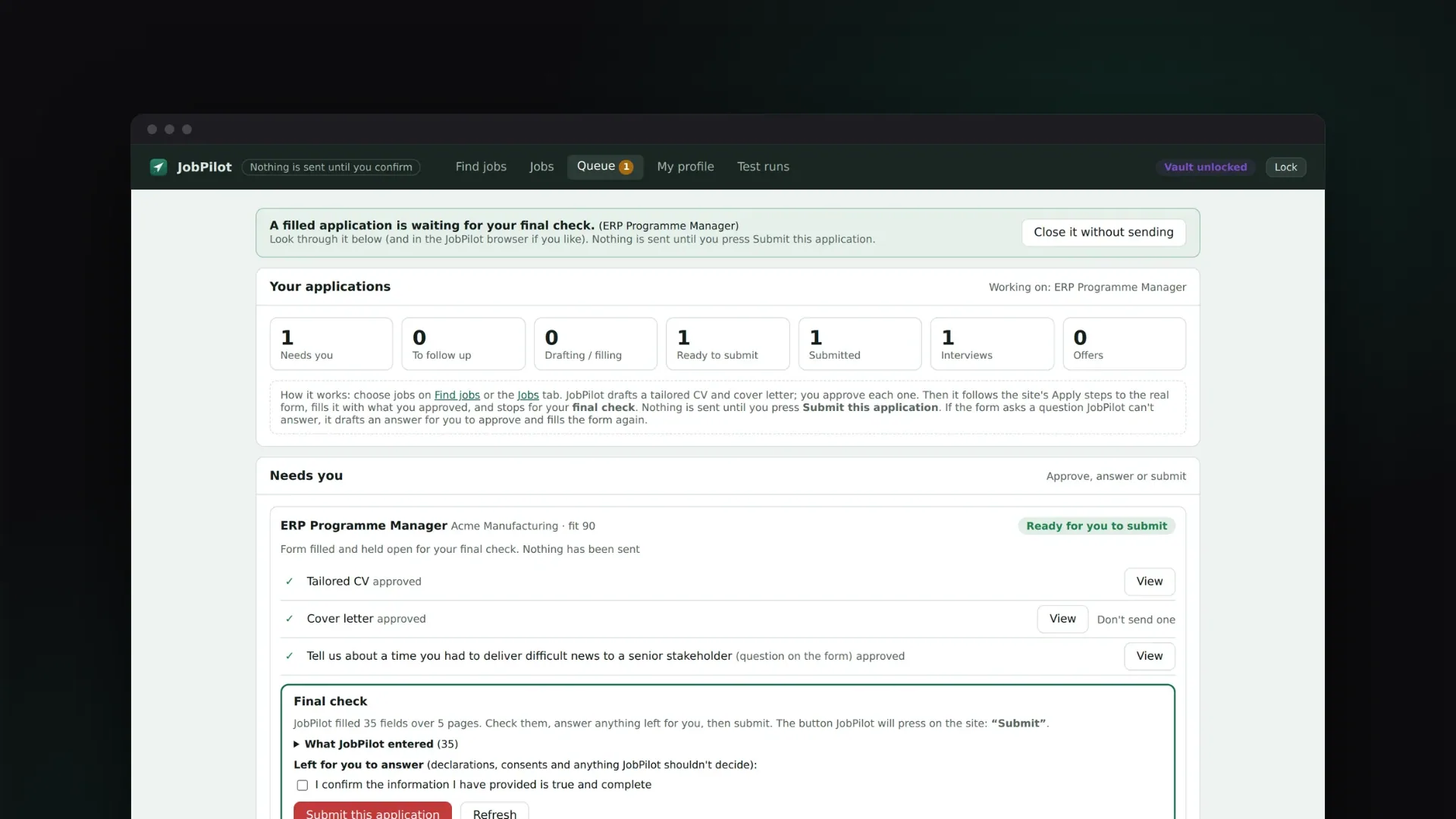
Once the candidate has approved those drafts, JobPilot follows the employer's apply journey in a dedicated Chrome profile, fills the form page by page, reads every value back and stops at a final check. It presses the site's submit button only after the candidate confirms that one application. CAPTCHAs, verification codes, declarations and consents are always left to the person.
The profile, documents, applications and job-site logins are kept in an encrypted vault on the user's PC. AI is optional: without it JobPilot works from deterministic rules and fixed phrasing, and when Claude is switched on it only sees work-related facts, never contact details, right-to-work status, salary or equality answers.
What it does.
Find jobs through approved routes
Saved searches run across Reed, Adzuna, Jooble, jobs.ac.uk, employers' public job boards, RSS feeds, Google Jobs (via SerpApi) and job-alert emails. A vacancy found on several sites becomes one entry that lists every source.
Fit analysis with the evidence shown
Each requirement in an advert is marked Met, Partial or Gap, with the profile evidence behind it. The fit score is calculated in code, never taken from an AI.
CVs, letters and answers backed by evidence
Every drafted sentence cites the role, STAR story or certification it rests on. A checker in code removes any sentence whose numbers, certifications or names cannot be found in those sources.
Form filling with read-back
Fields are matched to the profile by a deterministic cascade and filled across multi-page forms, including dropdowns, typeaheads, repeated job-history sections and file uploads. Every value is read back from the page to confirm it landed.
Final check and confirmed submit
JobPilot stops on the last page and shows exactly what it entered and which button it will press. It submits only when the candidate confirms that application, once.
Encrypted local vault
The profile, documents, drafts and job-site logins are encrypted on the PC and opened with a passphrase or recovery code. Every change is kept as a new version, and each backup is checked by decrypting it before it is trusted.
Tracker, follow-ups and insights
Every application has a timeline and an outcome, with a reminder to follow up when an employer goes quiet, CSV export, read-only Gmail or Outlook linking of employer replies and a simple funnel of what is working.
Chrome extension and Claude app link
A Chrome extension sends adverts to JobPilot and offers copy-assist on sites that forbid automation. An MCP server lets the Claude desktop app check progress and queue jobs, but it can never approve drafts or submit.
Audit trail and self-diagnosis
Every run keeps a tamper-evident audit log, screenshots and a field-by-field record. A setup check and redacted problem reports help diagnose issues without exposing personal data.
See it in action.
Screens captured from the working application using fictional demo data.
How an application gets from advert to submission
- 01
Build the profile
Import a CV in PDF or Word, check what JobPilot found, then add career stories and approved answers. Every save is a new encrypted version.
- 02
Find and assess jobs
Searches run across the chosen sources. Each vacancy is filtered against the candidate's criteria, merged with duplicates and scored against the profile.
- 03
Prepare and approve
JobPilot drafts a tailored CV and cover letter. The candidate edits and approves each item, and nothing unapproved is ever used.
- 04
Fill the application
The engine follows the apply journey to the real form, fills it with approved content and pauses for anything only a person should do.
- 05
Final check and track
The candidate reviews every value, answers the declarations and confirms. JobPilot submits, waits for the confirmation page and tracks the outcome.
How it's built.
JobPilot runs on the user's own Windows PC. A small Python service holds the encrypted data and the logic, a local web console shown in its own window is the interface, and an automation engine drives a dedicated Chrome profile to fill in forms. Apart from the adverts it reads and the employer sites it fills in, its only outside connections are to the job sources the user switches on, their own mailbox (read-only) and, optionally, the Claude API with minimal, work-related context.
Technically, it is a modular monolith. FastAPI listens only on the loopback address, checks the Host header and requires a custom header on every write. Background workers read adverts, run searches, work through the application queue, sync email and make backups. Playwright controls the browser, and SQLite stores every record separately encrypted with AES-256-GCM. Site knowledge lives in declarative adapters, job sources are self-contained plug-ins, and a local ATS simulator lets the whole pipeline be tested end to end without touching real employers.
- Desktop consoleSingle-page HTML and JavaScript in a pywebview (Edge WebView2) window
- Chrome extensionManifest V3: send a job, copy-assist; never fills
- Claude desktop appMCP server over stdio: read and queue only
- FastAPI console106 endpoints, loopback-only, with a write-header check
- Background workersAdvert reading, daily searches, application queue, email sync, backups
- Search and de-duplication8 source plug-ins, filters and cross-source merge
- Analysis and contentRules-first fit scoring; cited drafting and claim checker
- Form engineSnapshot, mapping cascade, executor, apply journey, submit guard
- Encrypted vaultSQLite; Argon2id-wrapped keys, AES-256-GCM per record
- Audit and run recordsHash-chained JSONL logs, screenshots, form snapshots
- BackupsEncrypted snapshots, checked by decrypting every record
- Job sourcesReed, Adzuna, Jooble, jobs.ac.uk, public ATS boards, feeds, SerpApi
- Employer application sitesReached through a dedicated Chrome profile
- Gmail and OutlookRead-only OAuth 2.0 with PKCE
- Claude API (optional)Anthropic SDK; redacted, work-related data only
Technology
Frontend
- Vanilla JavaScript SPA
- HTML and CSS
- pywebview (Edge WebView2)
- Light and dark themes
Backend
- Python 3.11+
- FastAPI 0.115+
- Uvicorn
- Pydantic 2
- Playwright for Python 1.55+
- RapidFuzz
- python-docx
- pypdf
- Chromium PDF output
Data
- SQLite
- Record-level encryption
- Versioned vault records
- Encrypted search cache
AI & ML
- Anthropic SDK (optional)
- Model set in configuration
- Sentence-level citations
- Deterministic claim checker
- Second-pass AI verification
Integrations & APIs
- Reed Jobseeker API
- Adzuna API
- Jooble API
- SerpApi Google Jobs
- Greenhouse and Lever boards
- Ashby and Workable boards
- SmartRecruiters and Recruitee boards
- RSS and Atom feeds
- Gmail API (read-only)
- Microsoft Graph (read-only)
- MCP over stdio
Auth & Security
- Argon2id key derivation
- AES-256-GCM
- HKDF subkeys
- OAuth 2.0 with PKCE
- Hash-chained audit log
- Loopback-only API
- DNS-rebinding defence
- Cross-site request defence
Hosting & DevOps
- Runs locally on Windows
- uv with a lockfile
- GitHub Actions CI
- Ubuntu and Windows runners
- Inno Setup installer
- Chrome Manifest V3
Testing & Quality
- pytest (391 tests)
- Headless Chromium end-to-end tests
- Local ATS simulator
- CAPTCHA and sign-in scenarios
- FastAPI TestClient
- Fake API transports
The hard parts, solved.
- 01
Making 'never submit without me' a guarantee
Every click the engine makes goes through a submit guard in code. Anything that looks like a final submit, or can't be classified, is refused unless the candidate has confirmed that application in the console. The authorisation names the exact button and the page's structural fingerprint, carries a one-time code from the final-check screen and is used up by a single click, and neither the MCP server nor the extension can grant it.
- 02
Stopping AI from inventing experience
Drafts are built sentence by sentence with citations to the profile. A deterministic checker requires every number, certification and proper name in a sentence to appear in the sources it cites, and failing sentences are removed rather than reworded. Confidence is calculated, not self-reported: only a verbatim approved answer is rated high. Certifications are matched exactly, so a Foundation certificate never satisfies a Practitioner requirement.
- 03
Reading forms that were never designed for automation
A snapshot script walks each page, including open shadow roots and iframes, to capture labels, options, required flags and errors. Each field is then mapped through a seven-step cascade: site adapter, mappings the user has confirmed on that site, autocomplete attributes, synonyms from a 45-field ontology, name or id, approved answers and fuzzy matching. Values are read back after filling, site validation errors trigger reformatting, and anything uncertain goes to the person.
- 04
Keeping personal data local and minimal
The vault derives separate keys for records, sensitive answers and files, and binds every ciphertext to its record type, id and version so records can't be swapped or replayed. It locks itself after 15 minutes idle, and background tasks never keep it unlocked. Contact details are parsed on the PC and redacted before any AI call, job-site passwords are only ever typed into sign-in and sign-up pages, and problem reports replace entered values with their length.
- 05
One apply journey across many different sites
Applications rarely start on the form. A page classifier recognises adverts, cookie banners, account choices, sign-in and sign-up pages, verification steps, closed jobs and one-click 'quick apply' buttons, and does the one safe thing at each: turning down optional cookies, applying as a guest where offered, signing in with the saved login, or stopping to wait for the person.
A working MVP, ready for trials on real job sites
The repository records phases 0 to 9 of the build plan as built, with unattended submission deliberately left out by the owner's decision. The code carries 391 automated tests, and GitHub Actions workflows are set up to run them on Windows and Ubuntu and to build the Windows installer. For this case study the application was run locally with a fictional candidate, fictional vacancies and the built-in ATS simulator: one application went through to a confirmed submission on the simulator and another stopped at the final check.
JobPilot shows how VNE approaches AI in sensitive workflows: code decides what is allowed, AI is optional and checked, the candidate's data is stored encrypted on their own device, and every action leaves an audit trail.
- Product strategy
- UX/UI design
- Full-stack development
- AI engineering
- Systems integration